
1D vs 3D
1D vs 3D
1D vs 3D
1D vs 3D
The Shortest Honest Answer
Choose 1D when the measurements that matter to you are vertical and you value a highly automated, mature vertical workflow.
Choose 3D when horizontal force direction, lateral control, braking, gait contacts, rotation, raw six-axis research data, or future measurement scope matters enough to justify the broader instrument.
Start with the task.
The Longer, But Honest Answer
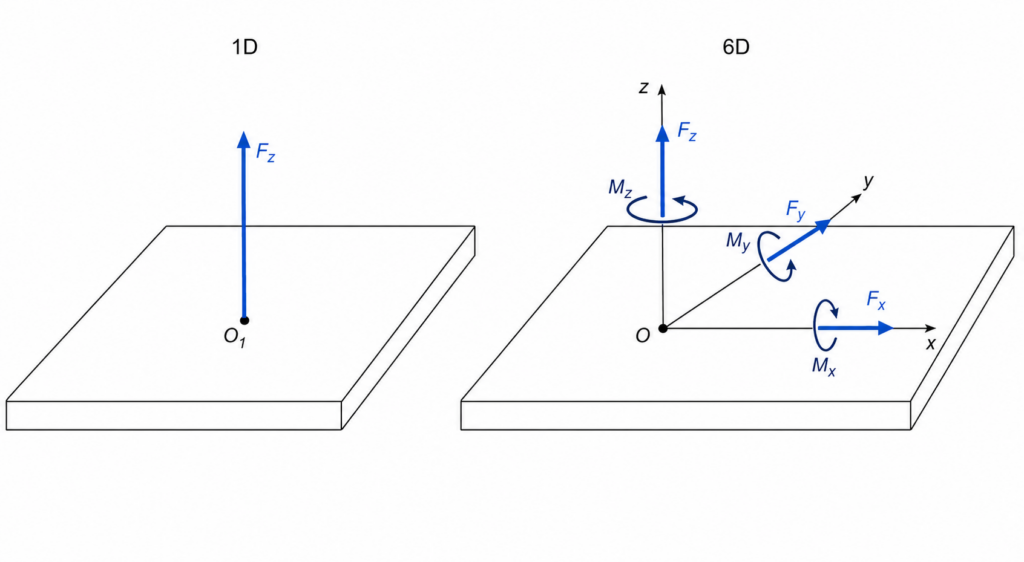
A 1D—or uniaxial—force plate measures vertical force. That is enough for many jumps, vertical isometrics, and other applications in which the decision is built from the vertical force-time curve.
However, a 3D force plate is also a 1D force plate.
A 3D—or triaxial/six-axis—plate also measures vertical forces; but also fore-aft and side-to-side forces, a six-axis system adds the moments about all three axes.
Start with what is actually measured
| Question | 1D vertical plate | Six-axis F1-3D |
|---|---|---|
| Vertical force, Fz | Measured | Measured |
| Fore-aft force, Fx | Not measured | Measured |
| Side-to-side force, Fy | Not measured | Measured |
| Moments Mx, My, Mz | Not measured as six-axis components | Measured |
| Bilateral vertical force | Yes with dual plates | Yes with dual plates |
| Vertical jump workflows | Strong fit | Strong fit |
| Horizontal-force questions | Cannot directly answer | Designed to measure |
| Raw 3D force and moment data | No | Yes |
Where 1D is usually enough
- Countermovement, squat, and drop jumps when the decision is based on vertical force-time behavior
- Vertical isometric testing
- Fast team testing centered on a mature automated protocol library
- Buyers who want the simplest path to vertical metrics and will not use 3D channels
- Environments where low weight and wireless mobility dominate the decision
For standard countermovement-jump monitoring, 3D channels may add little to the main decision. Jump height, vertical impulse, phase timings, and many vertical force metrics can be calculated from a trustworthy vertical signal.
This is why 1D systems became popular outside biomechanics laboratories: they reduced acquisition and analysis to a workflow that busy applied teams could repeat.
Where 3D begins to earn its place
- Acceleration and sprint-start force direction
- Braking and horizontal deceleration
- Change-of-direction contacts
- Gait and step contacts
- Tasks with meaningful side-to-side force
- Rotational tasks and vertical-axis torque
- Force-vector and coefficient-of-friction investigation
- Biomechanics teaching and six-axis research
- Buyers who want vertical work now and do not want to replace the hardware when the program expands
The key phrase is begins to earn. Measuring a component is not the same as having a validated protocol or a useful decision. The workflow, analysis method, and operator still matter.
A 3D plate can still run a vertical test
Choosing six axes does not mean every analysis must use six axes.
Fz remains available. A team can begin with familiar jump workflows and add multidirectional work later. This option value matters when the purchase horizon is longer than the current testing menu.
The reverse is not true. A 1D plate does not gain direct Fx, Fy, or moment measurement through an update.
We think this does not mean every buyer should pay for optionality. But think that optionality must be valued explicitly rather than discovered after a system is purchased.
The traditional objection to 3D is real.
Historically, 3D force plates have often meant:
- Longer setup and interpretation time
- Higher purchase cost
- Permanent or semi-permanent installation
- Careful surface and mounting requirements
- Raw data without an applied workflow
- More specialist analysis
However, with our F1-3D system we try to answer those workflow objections:
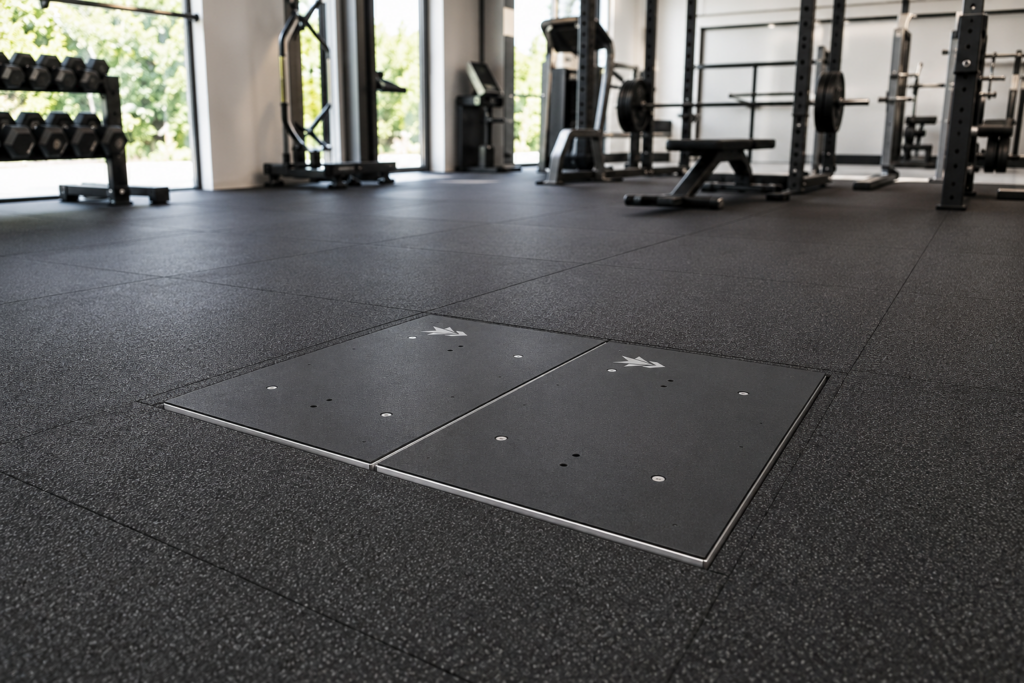
- 30 mm low-profile boards
- No permanent pit for suitable applied setups
- Saved-layout setup designed for live data in under 60 seconds
- Studio configuration, live display, review, current workflows, reports, and raw export
- AI assistance that starts after deterministic calculation to actually get value out of 3D force data, even with predominantly vertical tests.
- A complete dual system offered through the Founding 20 at €14,990 excluding VAT
- It does not erase physics. Dynamic horizontal tasks still require a stable surface, sensible cable management, and a setup that does not create a trip or slip hazard.
Compare the full buying model
| Buying factor | Typical applied 1D system | Movetrics F1-3D |
|---|---|---|
| Best at | Automated vertical workflows | Vertical plus horizontal forces and moments |
| Setup | Often mobile, lightweight/wireless | Wired Pilot; under 60 seconds for saved layout |
| Software maturity | Often broad protocol library | Focused current workflows; expanding roadmap |
| Core ownership | Often subscription-dependent | Perpetual core Studio license |
| Raw data | Varies by supplier and plan | Raw CSV included |
| Cloud dependence | Varies | Core workflow local/offline; reports and AI online |
| Modularity | Usually one dual pair | Supported layouts from one to ten boards |
| Purchase model | Varies; quote or subscription | Founding 20: €14,990 excl. VAT |
| AI | Varies | Transparent beta; metrics first, explanation second |
The five-question decision
- What movements will you measure in the first 90 days?
- Which force components must be measured directly?
- Will anyone use raw data or build custom analysis?
- How much protocol automation do you need on day one?
- Would replacing a 1D system later cost more than preserving 3D scope now?
Choose 1D if…
All high-value answers remain vertical, mature automation matters most, and the other components would go unused.
Choose F1-3D if…
At least one important workflow requires horizontal force or moments, raw six-axis access matters, or your organization wants a measurement platform broad enough to grow without a traditional lab installation.
Speak with Movetrics before deciding if…
Your use case is mixed, your first protocol is unusual, you need synchronization, or you are not yet sure whether the 3D channels would change a real decision.
Questions Movetrics buyers often ask before choosing
Is a 3D force plate always more accurate than a 1D plate?
No. Axis count and accuracy are different properties. A high-quality 1D plate can measure vertical force very well. Compare the published specification and evidence for the component you need.
Can software or AI turn a 1D plate into a 3D plate?
No. Software can derive useful variables from the measured vertical signal, but it cannot directly recover fore-aft force, side-to-side force, or three moments that were never measured.
Do vertical jumps need 3D measurement?
Usually not for standard vertical performance metrics. F1-3D’s value is that it still runs vertical workflows while preserving the other channels for different tasks or future work.
Is Movetrics a direct replacement for VALD ForceDecks?
It can be an alternative for buyers who value six-axis measurement, raw-data ownership, modularity, and perpetual core software. ForceDecks may remain the better fit for buyers prioritizing a large mature vertical workflow, lightweight wireless use, and the wider VALD ecosystem.