
Movetrics F1-3D
The Force Plate That Doesn’t Stop at Vertical.
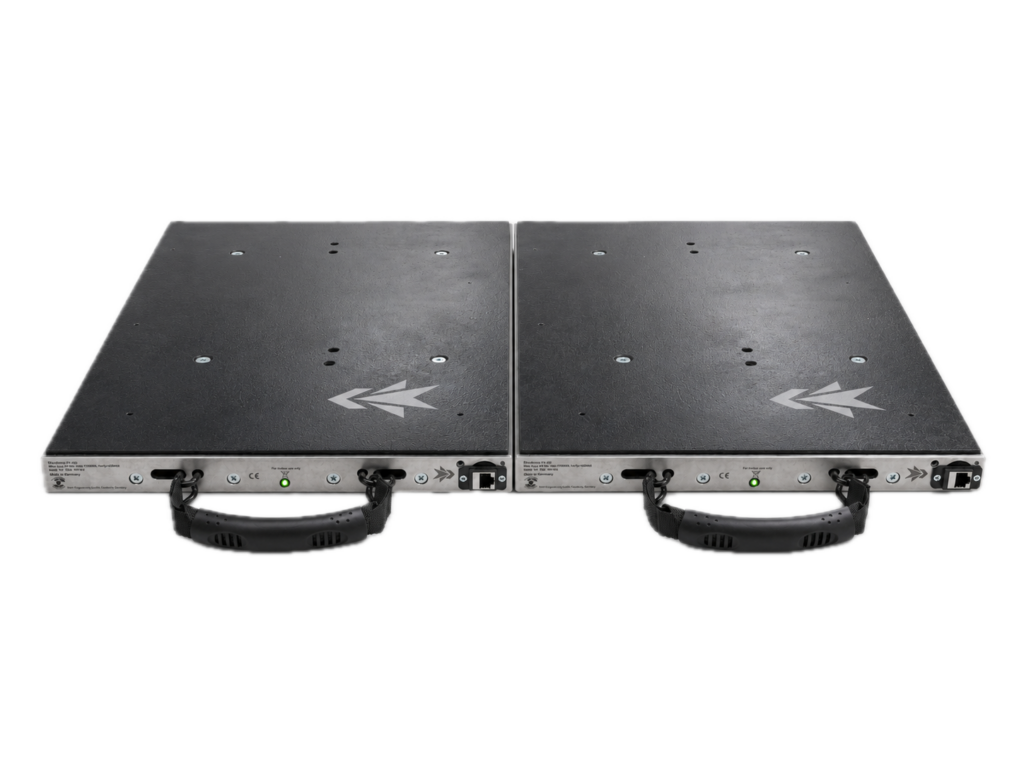
Movetrics F1-3D brings full six-axis 3D force measurement out of the biomechanics lab: two ultra-thin independent force plates, Movetrics Studio, AI-assisted analysis and accessible raw data—all in one portable system ready to measure in under 60 seconds.
- Patent Pending Technology
- Invented & Made in Germany
- 35+ Years Sensor Innovation
- Six axes per plate
- 2,000 samples/s/channel
- Two 30 mm plates
A 1D plate is not a lesser plate. It is a narrower instrument.
Vertical force is enough for many valuable workflows. A 1D dual-plate system can run countermovement jumps, squat jumps, drop jumps, vertical isometrics, and many strength tasks efficiently.
The constraint appears when the question changes:
- How much force was directed forward or backward?
- How did the athlete brake?
- What happened side to side?
- Was force redirected or merely increased?
- What rotational moment occurred about the vertical axis?
- Does the task involve a sprint start, cut, gait contact, push, or rotational action?
Software can derive many useful metrics from a vertical signal. It cannot recreate a horizontal force or a moment that the sensor never measured.
F1-3D keeps the vertical workflow and preserves the other five components. You do not have to use every channel in every test. You do get to decide later.

If your program will remain vertical, buy the strongest 1D workflow for your needs. If you want a broader measurement platform without a traditional lab build, examine F1-3D.
Six channels per plate, measured at the same time.
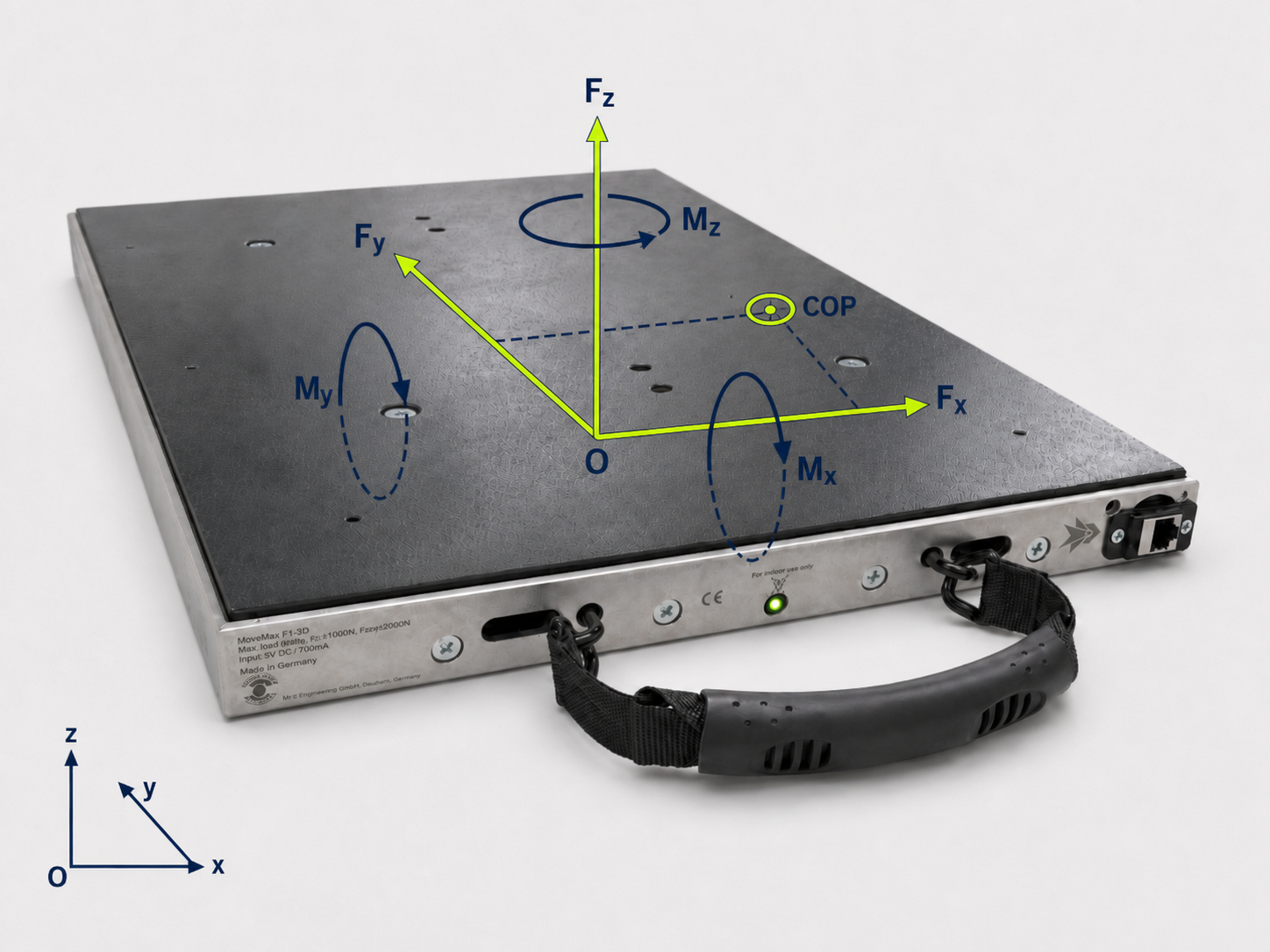
Forces:
- Fx — fore-aft force: The component acting along the plate’s forward/back direction.
- Fy — side-to-side force: The component acting along the plate’s lateral direction.
- Fz — vertical force: The component acting normal to the plate surface.
Moments:
- Mx — moment about the x-axis: Rotational effect about the fore-aft axis.
- My — moment about the y-axis: Rotational effect about the side-to-side axis.
- Mz — moment about the z-axis: Rotational effect about the vertical axis, often described as a free moment or torque in the surface plane.
A moment is not “extra force.” It describes the rotational effect of the applied loading about an axis. In some vertical jump questions, moments add little to the decision. In rotational tasks, stance analysis, force-application studies, and multi-segment models, they can be central.
We never intended to build a better force plate.
1. The Question
We never intended to build a better force plate.
Our inventor, Dr.-Ing. Saad Jabir, was having problems walking and went through gait analysis using technology he invented and developed more than 20 years earlier.
His first question was:
Why have so many orthopedic and biomechanical measurements changed so little in the last 20 years?
Our second question was:
Why are they still so expensive?
2. The Rest of the Problem
As we spoke with researchers, clinicians, universities, engineers, and other partners, we realized that price was only part of the problem.
3D force measurement could still mean pits in the floor, permanent installations, specialist hardware, complicated wiring, advanced software that requires training, and people who knew not only how to make the whole system work — but also what to do with 3D force data.
Our deeper question became: Why does measuring something as fundamental as how a person interacts with the ground have to be this complicated?
3. So we Built Something
Our first prototype was only 15mm high. And it worked.
It measured full 3D forces in a form factor that challenges many of our assumptions about what a 3D force plate had to look like.
But a prototype is not a product. We wanted something that is universal, could handle heavy jumps of big athletes, and be robust for intense daily use.
So we made it stronger, more robust, more practical. That became the F1-3D.
4. The we built the System Around It
The plate alone was not enough, we wanted easy to use software but also the compatability to existing motion capture software.
We built the Force Data Terminal, our Movetrics Studio software with high frequency synchronized sampling, data exports, PDF reports, and onboarding workflow around the same idea:
Keep the measurement capability but remove as much unnecessary complexity as possible.
The result is the F1-3D system: a robust but portable six-axis 3D force measurement system designed for the places where people actually train, teach, rehabilitate, and study movement.
5. Now We Prove It, With the People It Was Built For
The first customers and partners are now using F1-3D in real environments.
Our next phase is not about selling as many systems as possible.
We want to work with people who genuinely need better 3D force measurement: applied universities, biomechanics and physio teams, high-end gyms, sports performance centers, rehabilitation specialists, and other practitioners who understand the problem and want to help solve it.
Our dream customers are not passive buyers but partners who will challenge our system, use it in demanding real-world workflows, tell us what is missing, and help us prove where F1-3D creates real value.
That is why the next 20 systems are only available through our Founding 20 Pilot program.
We want these first 20 systems in the hands of the people who can help us turn a strong product into a new standard for practical 3D force measurement.
The Complete System
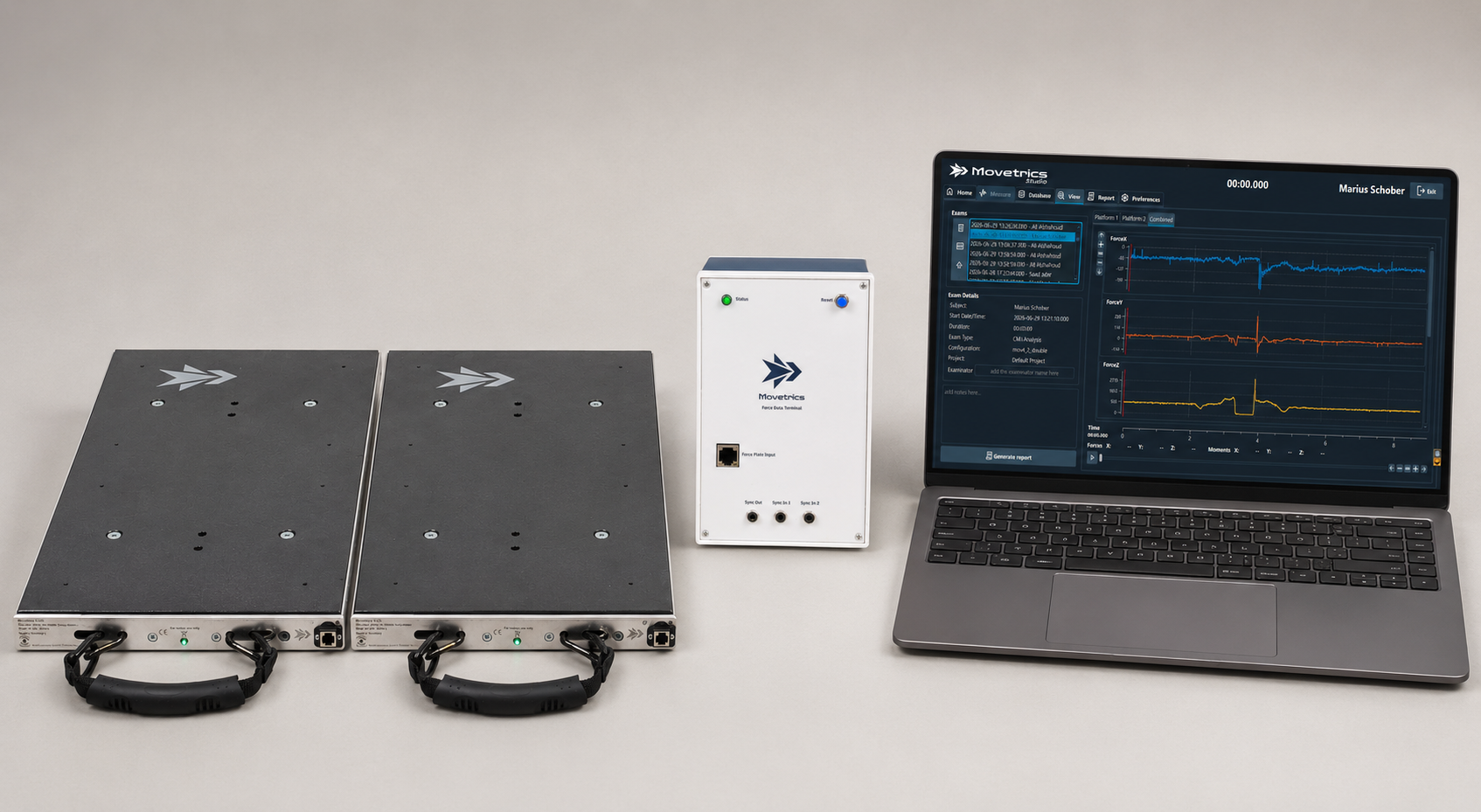
F1-3D is a fully integrated measurement system:
F1-3D Boards
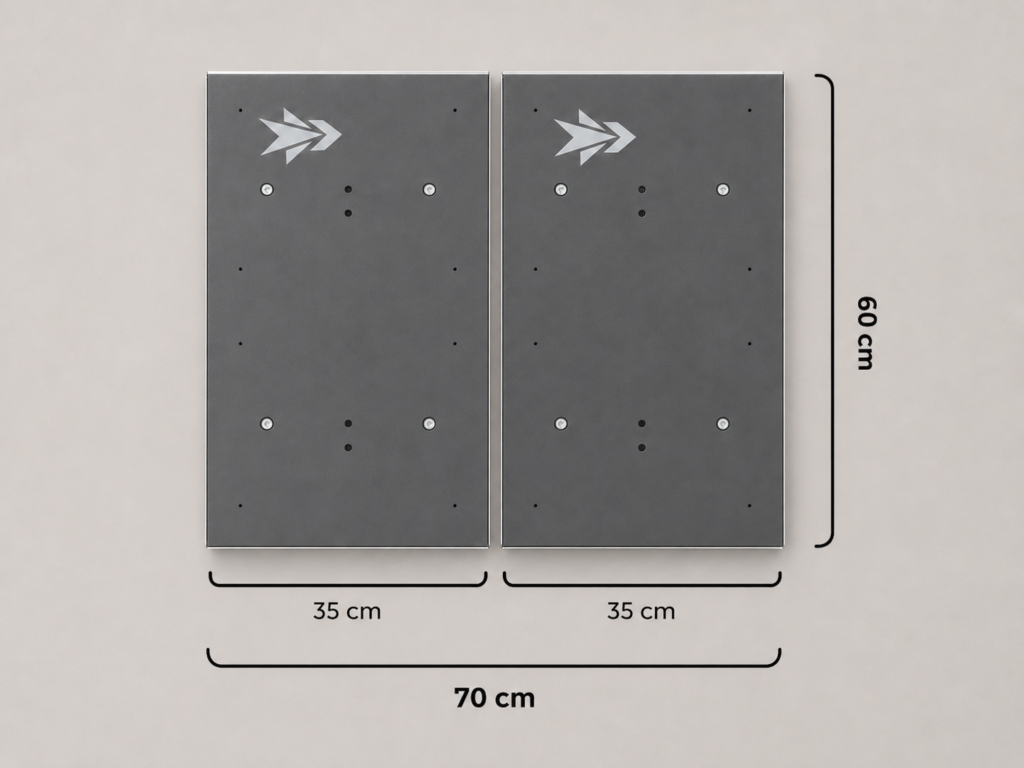
Each 600 × 350 × 30 mm board independently measures Fx, Fy, Fz, Mx, My, and Mz. A standard dual system creates a 600 × 700 mm surface when the boards are placed side by side.
Force Data Terminal
The FDT links the board chain to the Windows PC and provides the current Pilot’s wired measurement path. It also supports ±10 V analog outputs for all six measured components and Sync In/Out for wider measurement setups.
Movetrics Studio
Studio configures the board layout, acquires and displays live data, stores measurements locally, supports configured workflows, reviews force and moment channels, generates reports, and exports raw .CSV and .C3D data.
Movetrics AI
Studio remains responsible for deterministic signal processing and metric calculation. The AI receives selected calculated metrics, structured graph descriptions, and test context—not the raw signal—and helps explain the result.
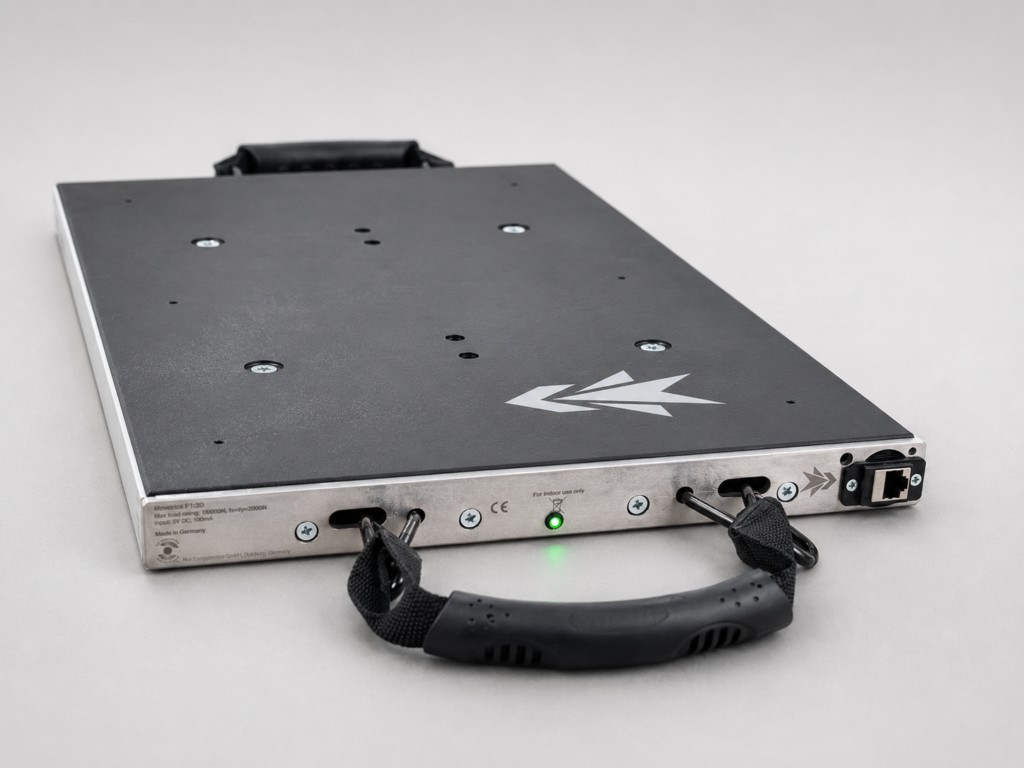
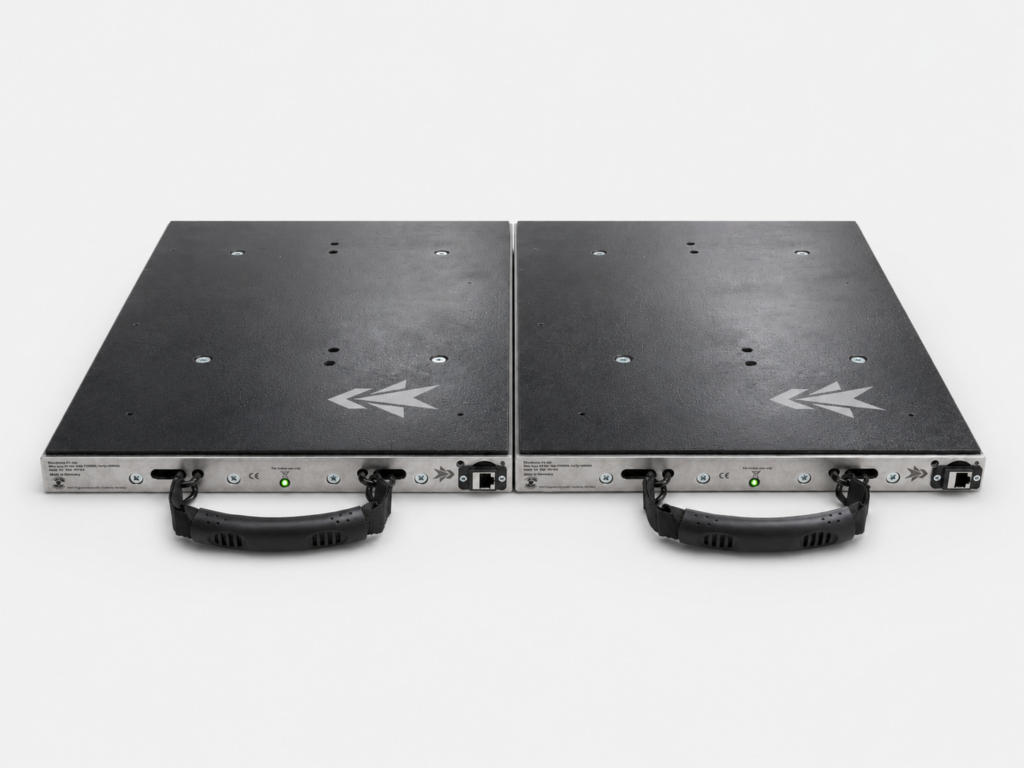
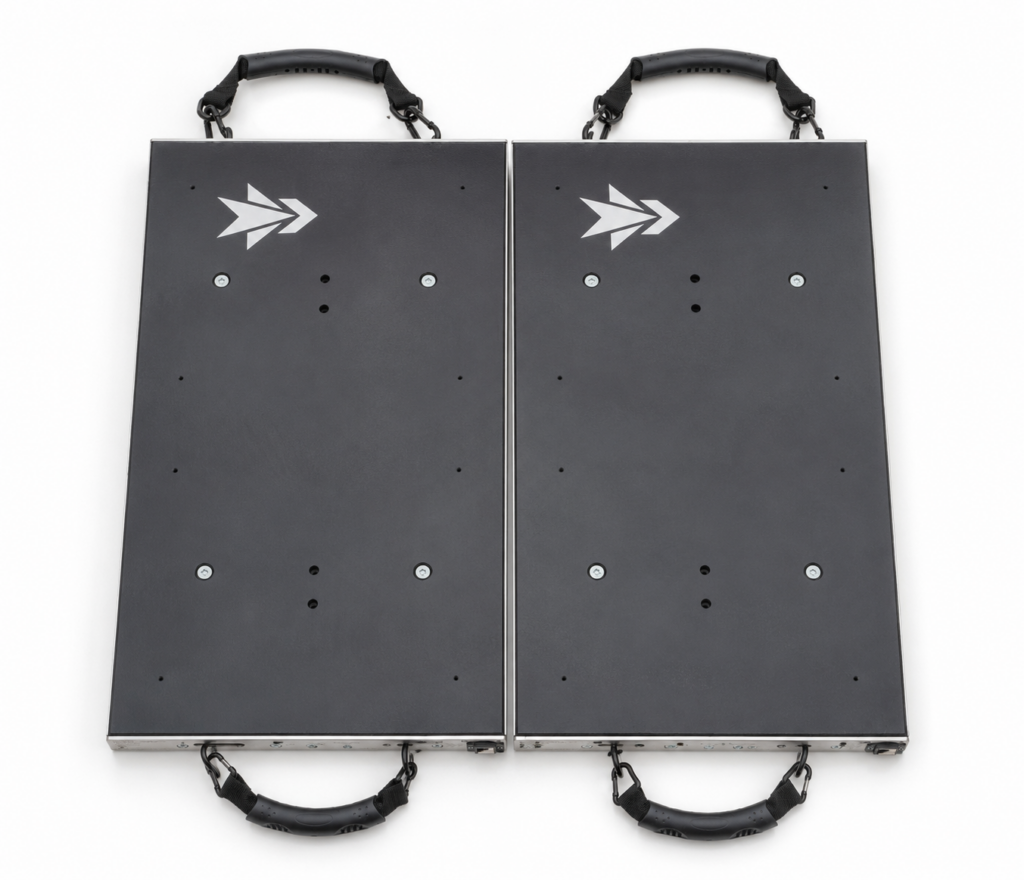
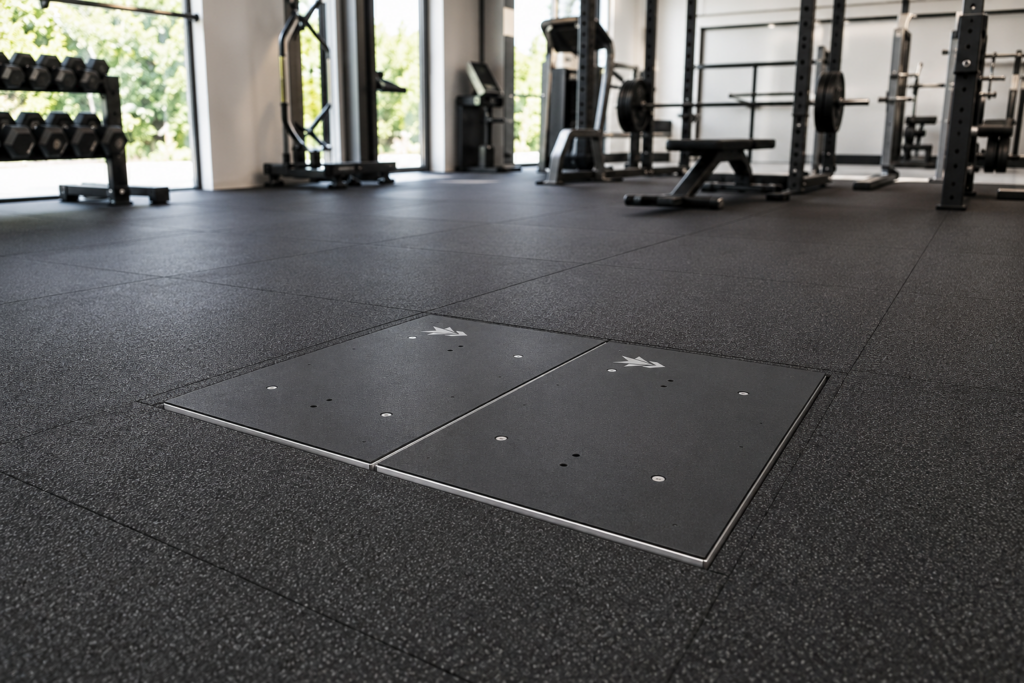
The complete F1-3D measurement chain is developed as one system—from the sensors, force plates, and electronics to data acquisition, Movetrics Studio and AI analysis.
Start measuring from a saved layout in under 60 seconds.
Our workflow allows to place and connect the F1-3D boards and view live-data in Movetrics Studio in less than 60 seconds.
- Place the boards on a suitable, stable, flat surface. (<20 seconds)
- Connect the boards with shielded Ethernet. (< 5 seconds)
- Connect the board chain to the FDT. (< 10 seconds)
- Connect the FDT to the PC via USB-C (< 5 seconds)
- Start Movetrics Studio & View Live Data (< 20 seconds)
Initial layout configuration normally adds two to three minutes.
Studio turns six-axis data into a repeatable workflow.
The F1-3D force plate system includes Movetrics Studio, the software carries each test from board configuration and live acquisition to review, reporting and complete raw-data export in seconds.
Select
Create or select the supported plate layout and choose from available guided test workflows.
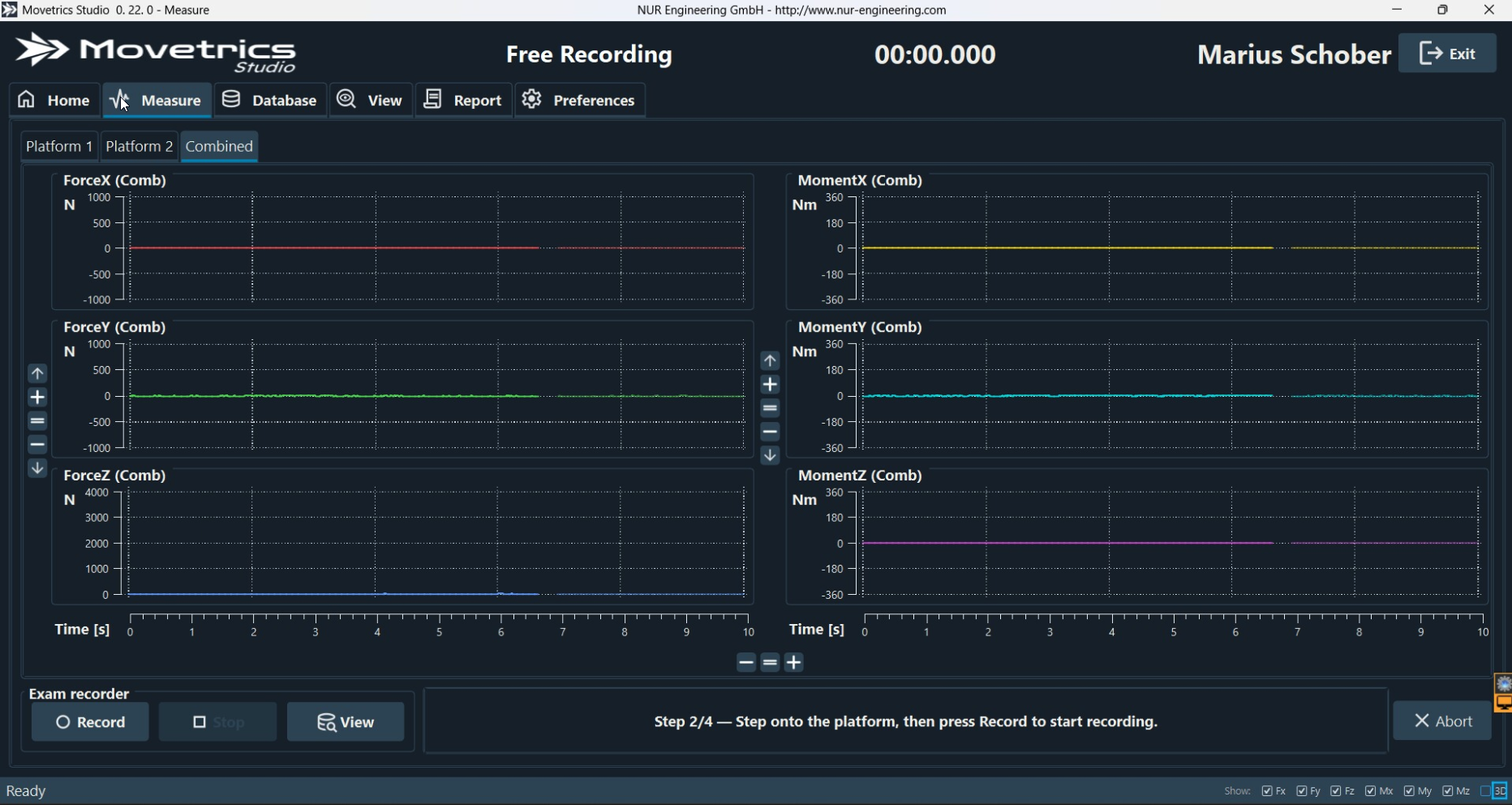
Measure
Acquire synchronized six-axis signals and watch force, moment, COP, and combined views live in a combined or per-plate view.

View
Inspect and replay the saved recording, platform channels, task execution, and test quality before relying on metrics or a report.
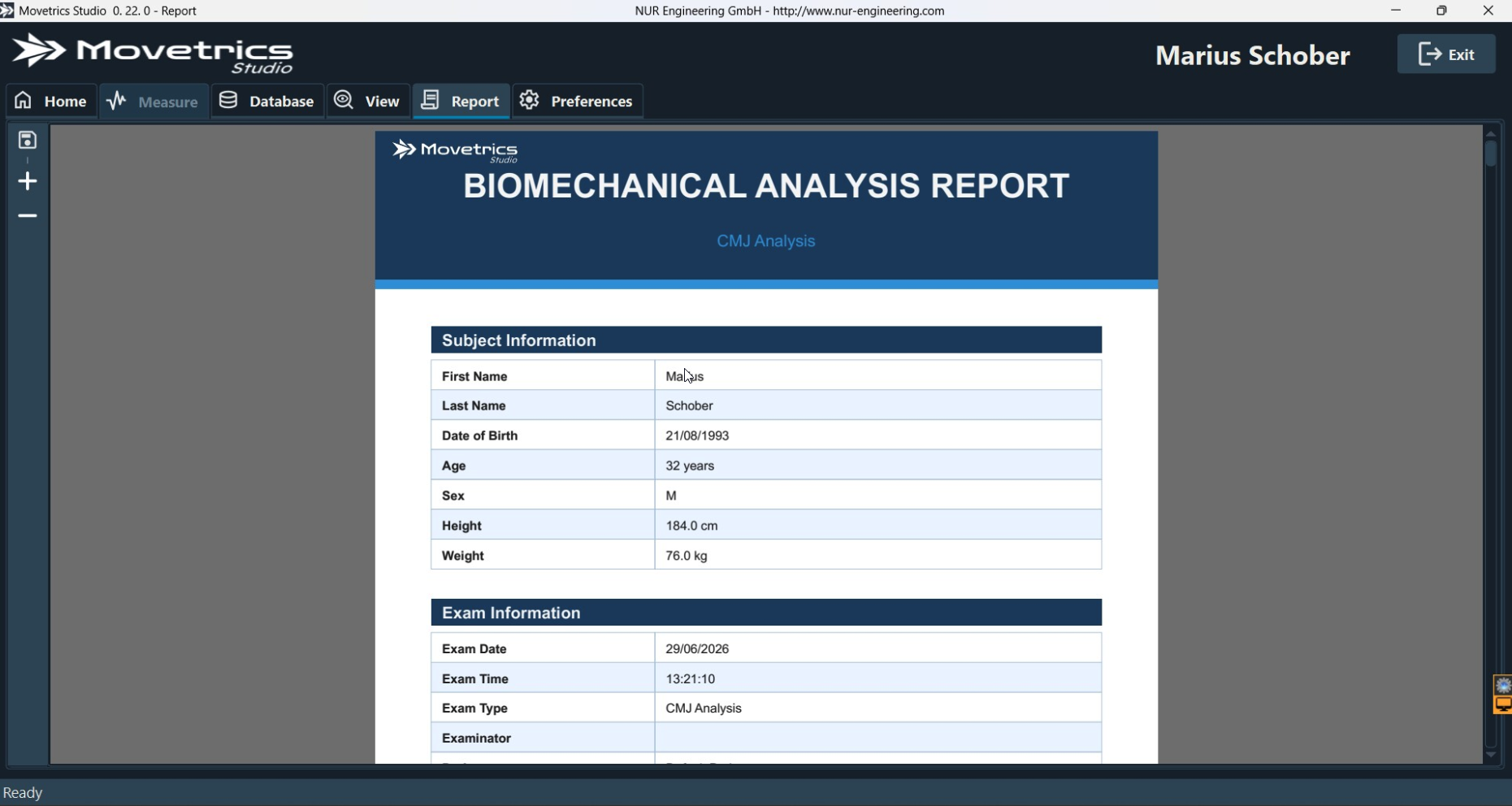
Report
Generate the configured report or retain the raw .CSV or .C3D for your own analysis.
Core calculations stay alway included in Movetrics Studio. No subscription to access your own measurements. Optional AI services may require a separate subscription after the beta period.
Movetrics Studio Overview
Movetrics Studio delivers all essential biomechanical calculations and visualizations—no additional software tools or complex setup required. Within one click, a PDF report can be created or raw data exported as a .CSV or .C3D file.
Home Screen
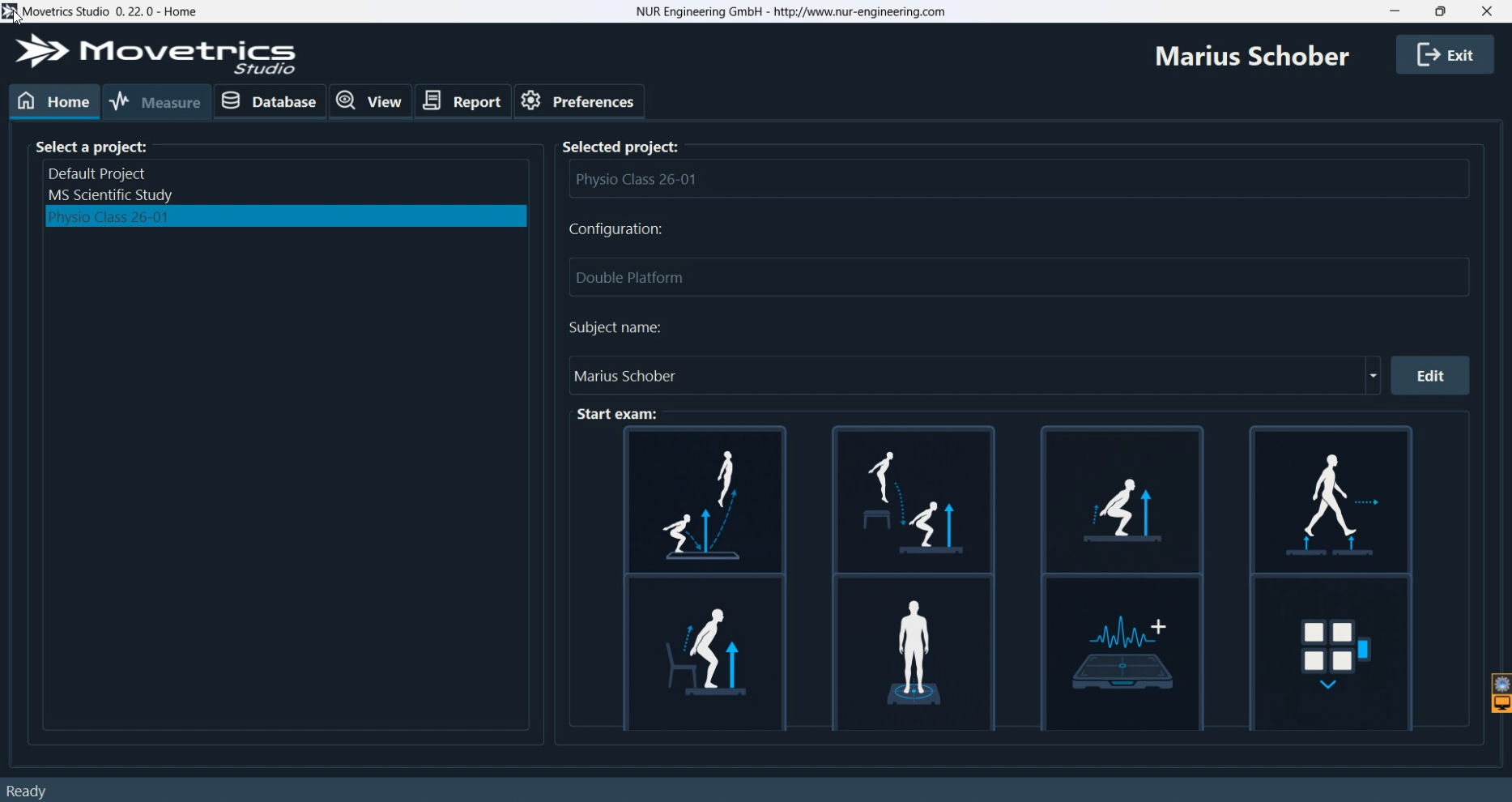
One the Home screen of Movetrics Studio, the user can select a project, select the configuration of the F1-3D boards, select the subject, and with 1-click start a guided exam or a free recording session.
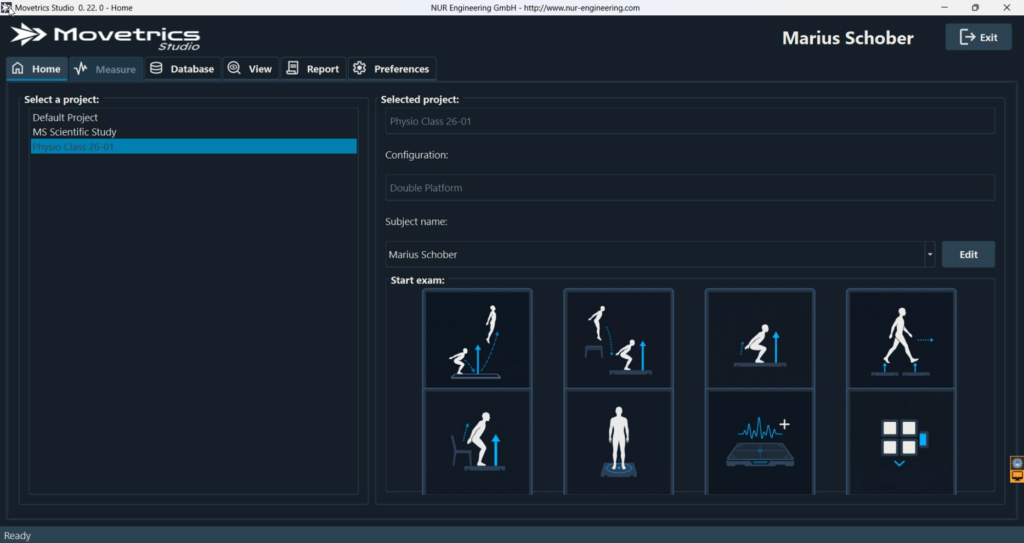
Current Guided Test Workflows:
Current guided exams include Countermovement Jump, Squat Jump, Drop Jump, Sit-to-Stand, Gait, Balance, and a Free Recording mode. More exam types for a variety of sports and rehabilitation purposes will be added continuously.
Measure Mode
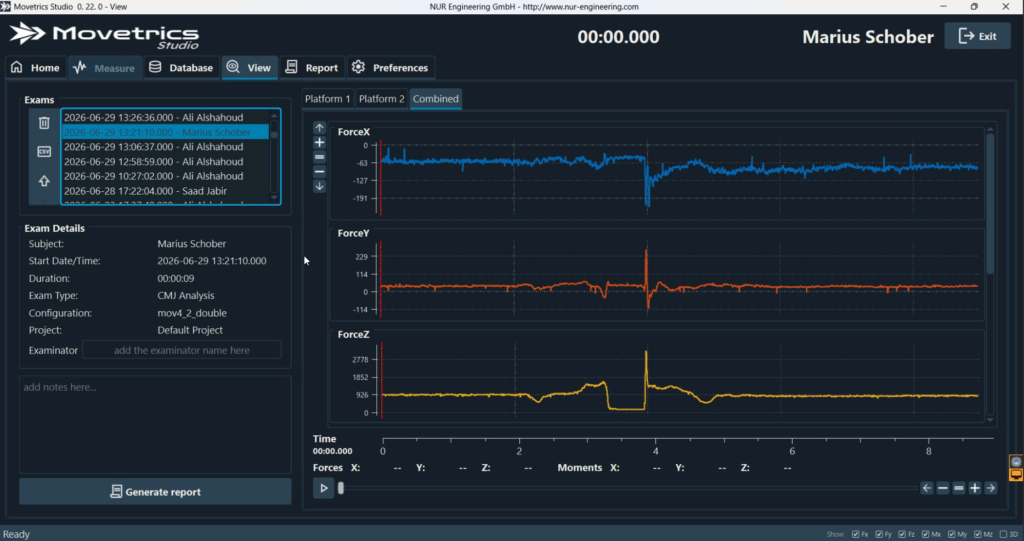
When starting Movetrics Studio, the user automatically enters “Measure Mode”, allowing him to see the live force and moment data and a 3D visualization of the COP — as a combined view or per board. The view can also be reduced to selected forces or moments (i.e. showing Fz and COP only).
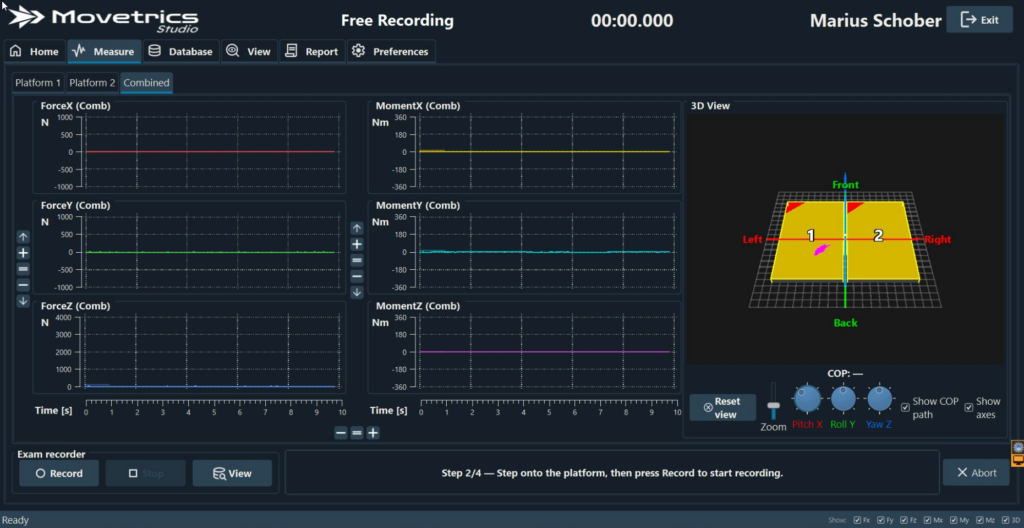
View Mode
An immediate View mode for just-recorded exercises. This view allows for real-time analysis where users can zoom in and out, and select the relevant force vectors to examine.
The raw data of the recording can be saved as a .CSV or .C3D file, or the user can generate a report, which calculates key metrics and visualizes the detected exercises in detailed graphs.
Report Mode
After the exercise has been reviewed and deemed as acceptable, the user can generate a detailed PDF report. The report provides comprehensive calculations, key metrics, and visualizations for the performed exercise.
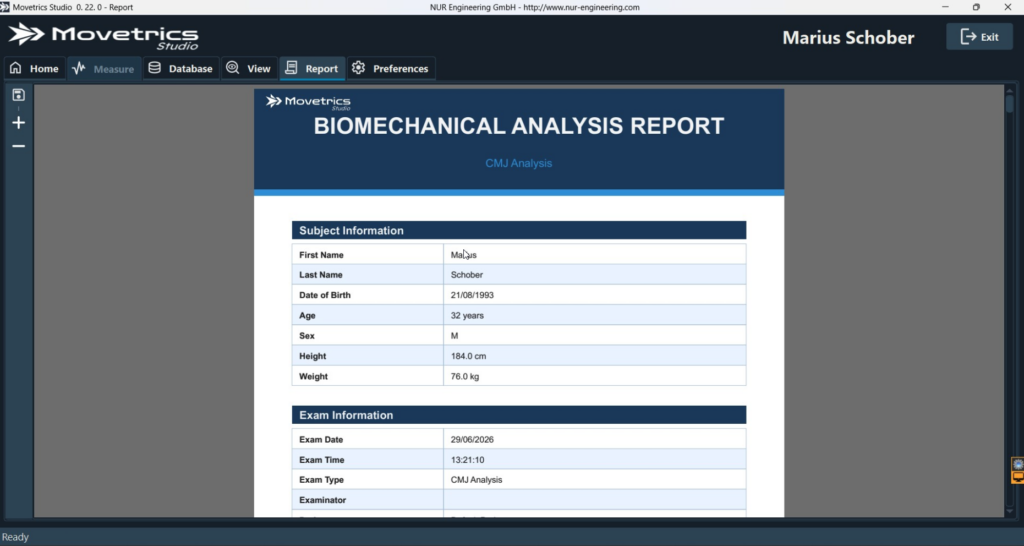
During the pilot phase, Movetrics AI is included in any report generation. The AI Report includes all metrics from the standard report and provides AI-driven insights to help users understand what the metrics mean in the context of their specific exercise test.
Excerpt of Calculated Metrics*
| Metric | Why it matters |
|---|---|
| Center of Pressure (CoP) | Shows where weight shifts under each foot—highlights balance issues or asymmetries. |
| Resultant force magnitude | Tells you “how hard” the ground is hit—key for monitoring overall load on joints. |
| Resultant shear force | Reveals sideways slip that stresses knees, ankles, or prosthetic sockets. |
| Resultant moment | Captures twisting torque—useful for spotting risky pivot or landing mechanics. |
| Force direction angle (3-D) | Indicates whether force is driven straight down or leaks sideways—guides technique fixes. |
| Force direction angle (shear-only) | Isolates horizontal push/pull to fine-tune stride or cut movements. |
| Loading rate (first-peak slope) | Flags rapid impact spikes linked to stress-fracture and overuse injuries. |
| Impulse | Measures total “push” over time—great for judging explosive power and propulsion. |
| Maximum force | Simple top number to track overall peak load and progress. |
| First peak force | Identifies initial shock on landing—crucial for return-to-play decisions. |
| Time to first peak | Shows how quickly impact hits; slower times often mean softer, safer landings. |
| Minimum force | Marks mid-stance unloading—helps verify smooth weight transfer. |
| Time to minimum force | Highlights timing of support phase; useful for gait retraining. |
| Time between first and second peak | Maps full stance cycle—helps coaches and physios spot stride or jump‐landing rhythm issues. |
*When generating a report, the calculated metrics depend on exam type and may include but are not limited nor must include to the stated.
Start with two. Expand the measurement area around the task.
Your system grows with your needs. Add plates anytime. Perfect synchronization guaranteed.
1
60 x 35 cm
Bilateral stance, squats, jumps
2
60 x 70 cm
Bilateral stance, squats, jumps
3
105 x 60 cm
or staggered
Multi-phase gait, step analysis
4
120 x 70 cm
or 140 x 60 cm
Gait runway, sprint starts
5+
Custom
Complete walkway, wheelchair testing
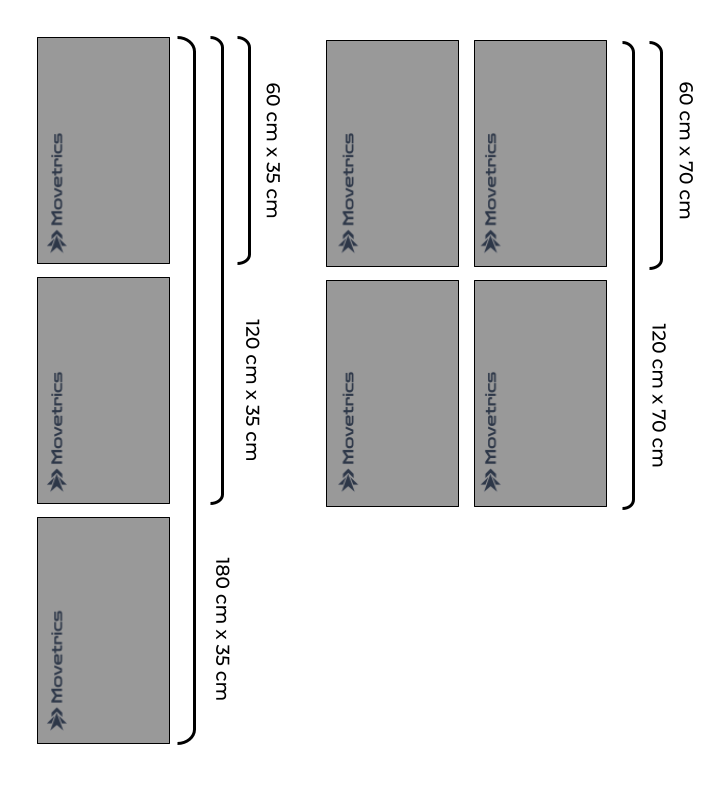
Configure side-by-side, front-to-back, or custom patterns. For more than 10 units in perfect sync.
The value is not the maximum board count but in the ability to define the surface around the protocol: bilateral jumping, separated stance, sequential contacts, teaching layouts, or a larger applied measurement area.
Why F1-3D Is Different
30 mm
Ultra-Thin by Design
Full six-axis force measurement in a plate only 30 mm high. Use F1-3D directly on the floor, integrate it into standard rubber gym floor tiles, or transport it between locations.
6 Axes
The Full Force Picture
Each F1-3D independently measures Fx, Fy, Fz and Mx, My, Mz. See vertical, horizontal and lateral forces, moments and Center of Pressure—not just what happens up and down.
2,000 Hz
High-Fidelity Measurement
Simultaneous acquisition at up to 2,000 samples per second per channel captures fast events from explosive jumps to subtle changes in stance, gait and balance.
< 60 Sec.
From Case to Measurement
F1-3D was built for use outside permanent laboratory installations. Connect the plates, FDT and computer, open Movetrics Studio and go from transport case to live data view in under 60 seconds.
25 m
Put the Plates Where Measurement Happens
Shielded Ethernet allows the force plates to operate up to 25 metres from the Force Data Terminal. Put the measurement area on the training floor, beside the treatment area or inside an experimental setup while keeping the computer where it belongs.
RAW C3D
Your Measurement. Your Data.
Use Movetrics Studio for guided workflows and analysis—or access the underlying force and moment data directly. Export the data as .CSV or .C3D, investigate it yourself, build your own analyses and integrate F1-3D into research workflows.
Technical Specifications
Physical Specifications
Physical Specifications
| Specification | Single F1-3D | Dual System |
| Dimensions | 600 × 350 × 30 mm | 600 × 700 × 30 mm combined* |
| Dimensions, imperial | 23.6 × 13.8 × 1.18 in | 23.6 × 27.6 × 1.18 in combined* |
| Weight | 20 kg (44.1 lb) | 40 kg (88.2 lb) total |
| Operating Temp | 5°C to 40°C | 5°C to 40°C |
*Nominal combined footprint when two plates are positioned side by side.
Force & Moment Capacity
Each F1-3D independently measures Fx, Fy, Fz, Mx, My and Mz.
| Specification | Single F1-3D | Dual System |
|---|---|---|
| Nominal vertical load Fz | 10,000 N | 20,000 N total |
| Maximum safe vertical load Fz | 12,000 N | 24,000 N total |
| Nominal horizontal load Fx, Fy | ±2,000 N | ±2,000 N per plate |
| Maximum safe horizontal load Fx, Fy | 3,000 N | 3,000 N per plate |
| Nominal moment Mz | 2,000 N·m | 4,000 N·m total |
| Maximum moment Mz | 3,000 N·m | 6,000 N·m total |
| Maximum moment Mx | ±900 N·m | ±900 N·m per plate |
| Maximum moment My | ±600 N·m | ±600 N·m per plate |
| Maximum overload moment Mx / My | 6,000 N·m | 6,000 N·m per plate |
Measurement Performance
| Measured channels | Fx, Fy, Fz, Mx, My, Mz |
| Static resolution Fz | ≤1 N |
| Digital resolution Fz | <0.05 N/LSB per sensor |
| Linearity | ±0.5% FS |
| 3D force accuracy | ±0.5% FS |
| Center of Pressure accuracy | Validation in progress |
Data Acquisition
The Movetrics FDT — Force Data Terminal — connects the F1-3D force plates with Movetrics Studio on a Windows PC.
It handles communication, power, synchronization and real-time transfer of force and moment data between the force plates and the computer.
| A/D conversion | 16-bit |
| Acquisition | Simultaneous, synchronized |
| Acquisition rate | 2,000 samples/s per channel |
| Analog interface | ±10 V for Fx, Fy, Fz, Mx, My and Mz |
Connectivity & Synchronization
The force plates connect to the FDT using shielded Ethernet network cables. This allows the measurement area to be positioned up to 25 metres from the computer. The FDT connects directly to the PC via USB-C.
| F1-3D ↔ F1-3D | Shielded Ethernet network cable |
| F1-3D → FDT | Shielded Ethernet network cable |
| FDT → PC | USB-C |
| F1-3D → PC, local* | Wi-Fi |
| F1-3D → Movetrics Cloud* | Wi-Fi |
| F1-3D → mobile devices* | Bluetooth and Wi-Fi |
| Sync In / Sync Out | 3.5 mm mono jack |
| Analog Out | DB-25 female connector |
| Maximum F1-3D → FDT cable length | Up to 25 m |
*During the Founding 20 pilot phase, measurements require a Windows PC and the included Force Data Terminal (FDT) via wired connections. The shipped F1-3D hardware is already equipped with Wi-Fi and Bluetooth technology, which will enable wireless cloud-based tests with mobile devices and web browsers. Cloud functionality will become available in future updates.
Power & Storage
The F1-3D force plates are powered by the FDT which is connected to one plate via an Ethernet network cable. The FDT is either powered via USB-C connection directly via the PC or with a separate 9V power supply that is included in the delivery.
| Battery runtime | More than 3 hours |
| Charging | USB-C |
| Local storage | SD card |
| Storage capacity | up to 1 TB |
Higher-Load Configurations
On custom request, the F1-3D system can be manufactured and offered with Fz: 20,000 N per board / 40,000 N dual system. Max Mx and My will increase accordingly.
Own the core workflow. Keep the evidence.
F1-3D is designed around a straightforward ownership model:
- Perpetual license for the Studio core calculations supplied with the system
- 24 months of software updates included for Founding 20 customers
- Raw .CSV and .C3D export
- Local measurement database
- Optional AI subscription only after the included beta period
Raw access matters for more than flexibility. It lets a qualified customer audit calculations, build an independent workflow, preserve a research record, and move data into an approved analysis environment.
Built for where movement actually happens
From physiotherapy and sports performance to teaching and research, F1-3D brings full 3D force measurement into everyday workflows—without requiring a dedicated biomechanics lab.
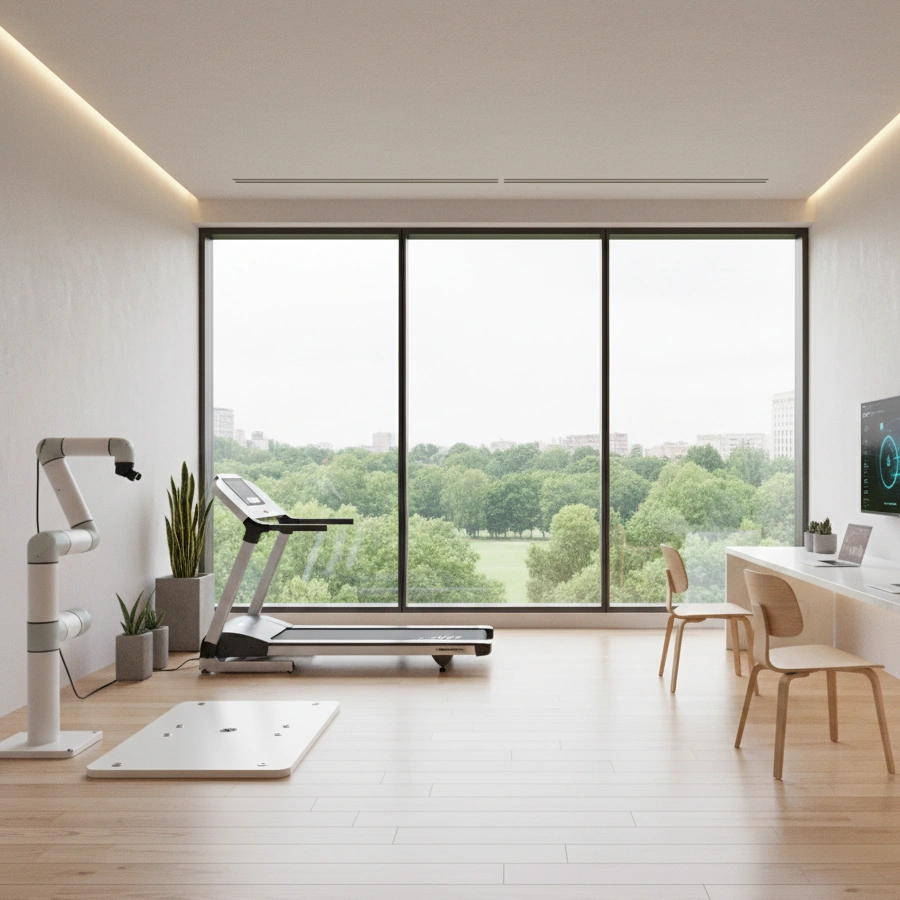
RESEARCH & EDUCATION
Full six-axis data without building the room around the force plates.
Measure Fx, Fy, Fz, Mx, My and Mz at up to 2,000 Hz per channel, access the raw data, synchronize external systems and configure the setup around your experiment.
Use F1-3D for research, teaching, method development and applied biomechanics—from a permanent installation to measurements outside the lab.
SPORTS PERFORMANCE
Keep the workflows you know. Add the forces you have been missing.
Run jumps, strength tests and performance assessments as you would with a conventional force plate—then go beyond vertical force.
Measure braking and propulsion in three dimensions, compare left and right independently, and investigate lateral and horizontal forces, moments, landings and movement strategies that Fz alone cannot show.
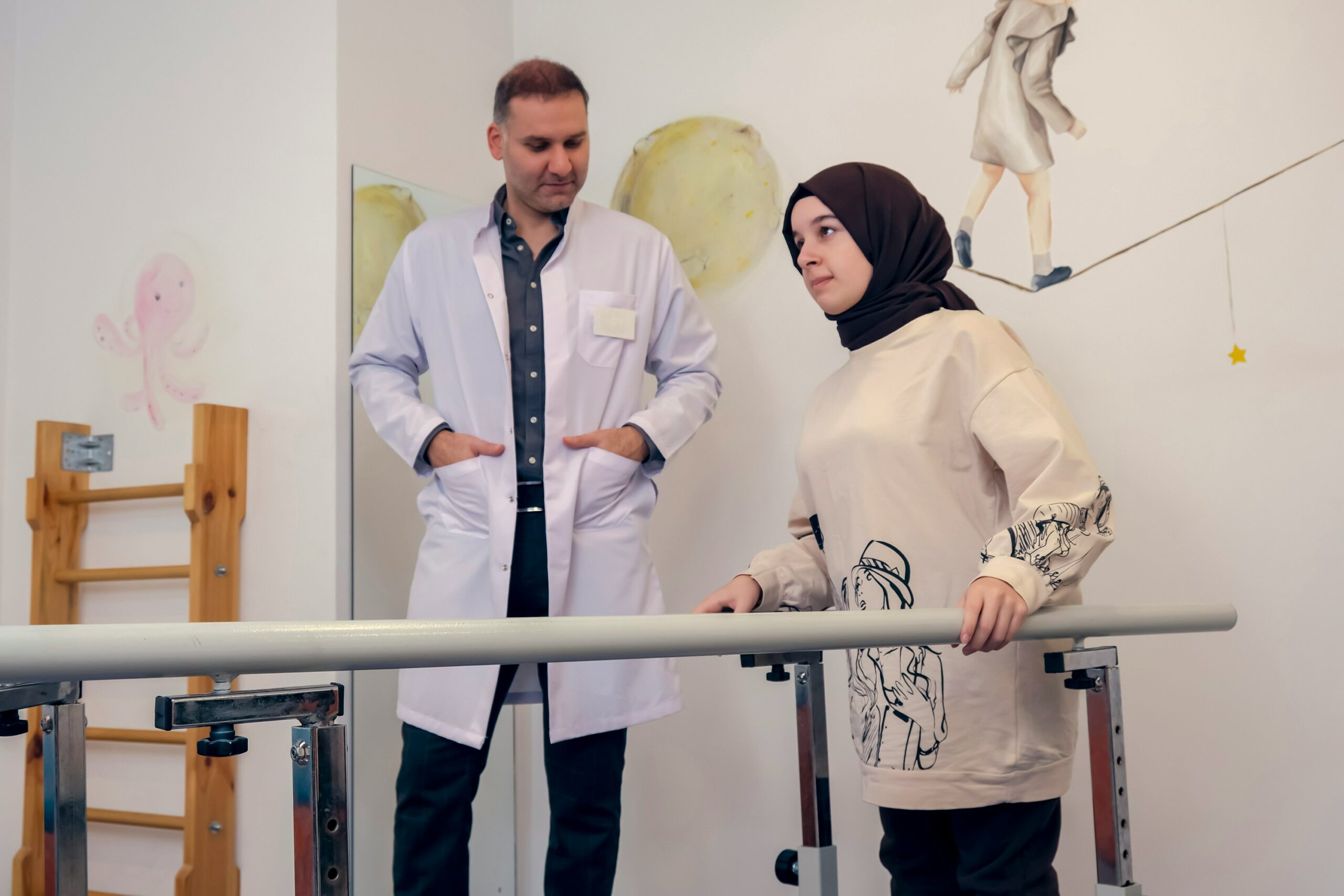
REHABILITATION
See more than whether someone got stronger. See how they move.
Measure gait, balance, sit-to-stand, jumps and other functional movements with objective force, moment and Center of Pressure data.
Track asymmetries, directional loading and changes over time—and add another layer of objective information to rehabilitation, return-to-performance and movement assessment.
Movetrics Studio lets you keep simple workflows simple—and gives you forces, moments and Center of Pressure across all three dimensions when the movement, athlete, patient or research question demands a deeper look.
F1-3D is a strong fit when…
- You want vertical jump workflows now and a broader measurement platform later.
- Your questions include force direction, braking, lateral control, gait contacts, or rotation.
- You value raw-data access and a perpetual core-software license.
- You need a low-profile system without committing to a permanent laboratory pit.
- You want close onboarding around one real 90-day use case.
A simpler 1D system may be enough when…
- Your work is limited to vertical jumps and vertical isometrics.
- You want a mature library of automated vertical tests above all else.
- You will not use horizontal-force or moment channels.
- Your team does not have a defined application for 3D data and does not want to develop one.
What Opens up When You Measure More Than Vertical Force
F1-3D covers the familiar force-plate workflows you may already use—then opens up applications where force direction, moments and Center of Pressure become important. From sports performance and rehabilitation to gait, balance and research, the same six-axis measurement platform can answer very different questions about how people produce, absorb and redirect force.
Sports Performance
Understand how athletes produce, absorb and redirect force.
- Countermovement Jump
- Squat Jump
- Drop Jump & RSI
- Isometric strength testing
- Landing & deceleration analysis
- Lateral and directional movements
- Asymmetry profiling
Useful for: performance profiling, monitoring adaptations, return-to-performance and understanding movement beyond vertical force.
Rehabilitation & Physiotherapy
Measure the movement behind the outcome.
- Sit-to-Stand
- Bilateral & unilateral loading
- Jump progression
- Landing assessment
- Weight-transfer tasks
- Functional strength tests
- Return-to-performance testing
Useful for: tracking changes over time, identifying compensations and quantifying how load is distributed between limbs and directions.
Gait & Locomotion
See every step in three dimensions.
- Walking gait
- Running gait
- Ground reaction force profiles
- Braking & propulsion
- Mediolateral forces
- Center of Pressure path
- Left-right comparison
Useful for: understanding stance, propulsion, loading strategies and asymmetries that vertical force alone cannot fully describe.
Balance & Postural Control
Turn subtle movement into measurable data.
- Quiet standing
- Single-leg stance
- Eyes open / closed
- Center of Pressure analysis
- Weight shifting
- Perturbation protocols
- Fatigue or repeated assessments
Useful for: quantifying postural control, sway, directional stability and changes that may be difficult to observe visually.
Education & Research
Measure the question, not just the predefined test.
- Custom protocols
- Raw 6-axis recordings
- Force-time analysis
- External synchronization
- Analog integration
- Repeated-measures experiments
- Teaching biomechanics
Useful for: experimental biomechanics, method development, student education and studies that require access to the underlying measurement data.
Specialized & Custom
When the standard test is not enough.
- Sport-specific movements
- Prosthetic & orthotic testing
- Footwear and surface studies
- Wheelchair propulsion
- Equipment interaction
- Ergonomic tasks
- Custom movement protocols
Useful for: applications where forces, moments and Center of Pressure matter but conventional force-plate workflows were never designed for the task.
Movetrics Studio already provides guided workflows for key assessments. Free Recording gives you access to the full measurement system today. With your feedback, we are now expanding Studio with additional strength, rehabilitation, gait, balance and sport-specific assessments—without changing the underlying hardware.
Our Founding 20 Program
Two ultra-thin 3D force plates. Twelve synchronized measurement channels. 2,000 samples/s/channel. Live analysis, AI reports, and complete raw data in Movetrics Studio.
Traditional 3D Dual Plate Systems
€30,000 — €40,000+
Movetrics F1-3D (Dual Plate)
€14,990
all incl.
The stated price and our all-inclusive offer are exclusive to the first twenty Movetrics F1-3D systems which are available only after application for 20 selected organizations.
What our Founding 20 Customers receive.
Our Founding 20 is not crowdfunding and it is not a reservation for an unfinished idea. Founding 20 is a limited commercial Pilot for organizations ready to put a finished, working Movetrics F1-3D system into meaningful use.
For €14,990 excl. VAT:
- A numbered Founding 20 system
- Two F1-3D plates and Force Data Terminal
- Site-matched cable and synchronization kit
- Perpetual Movetrics Studio core software
- 24 months of software updates
- Current and all future workflows
- PDF reports and .CSV and .C3D export
- 12 months of Movetrics AI beta access
- 10 copies of the printed Founding Edition of The Complete Guide to 3D Force Data
- 24 months of personal priority support
- A 90-day success plan
- Five-year limited B2B hardware warranty
- One installation and enablement visit in the EU service area
- Personal commissioning and primary-workflow configuration
- Two hours of on-site training after first configuration
- Direct influence over the protocols and workflows we integrate next
- The right to purchase up to 10 additional identical dual systems for identical conditions within 18 months
Our Live-Data Guarantee
At delivery, both plates must stream all six components, record the agreed workflow, and produce a .CSV or .C3D export or Studio PDF report. If Movetrics cannot make the agreed system work within 30 days, the customer may return it for a full refund of the system price.
Frequently Asked Questions
Does F1-3D measure vertical jump metrics?
Yes. Fz is one of the six measured components, and Studio includes configured Countermovement Jump, Squat Jump, and Drop Jump workflows. Exact metric availability depends on the installed release.
Why do moments matter?
Moments describe the rotational effect of loading about an axis. They can add information in rotational tasks, stance and force-application analysis, and research models. They are not automatically valuable in every test, and Movetrics does not claim otherwise.
Is F1-3D wireless?
Yes, but. The hardware already ships with Wi-Fi and Bluetooth. But during the Founding 20 pilot, the measurement path is wired. Direct Wi-Fi, cloud Wi-Fi, Bluetooth, and mobile workflows are on our roadmap and will become available soon.
Can I access raw data?
Yes. Studio exports raw CSV and .C3D data. Keep the exact software version, sampling configuration, axis convention, and protocol with any analysis record.
Is CoP available?
Yes. Movetrics Studio displays and records detailed center-of-pressure 3D live-views and calculates the CoP path.
Can F1-3D synchronize with other equipment?
The FDT provides Sync In/Out and ±10 V analog outputs for all six measured components. Our current integration efforts are primarily for synchronized Noraxon-based setups. Please confirm the exact third-party configuration before ordering; this is not a blanket compatibility claim or formal partnership.
What computer is required?
The current Movetrics Studio workflow runs on standard ±500€ Windows PCs. When ordering, we can recommend a suitable PC to purchase separately.
What happens if the early system does not work?
Our Founding 20 live-data guarantee requires all six components from both boards, the agreed workflow, and either a raw export or Studio report. Movetrics will fix the issue; if the agreed system cannot be made operational within 30 days, it may be returned for a full refund of the system price.