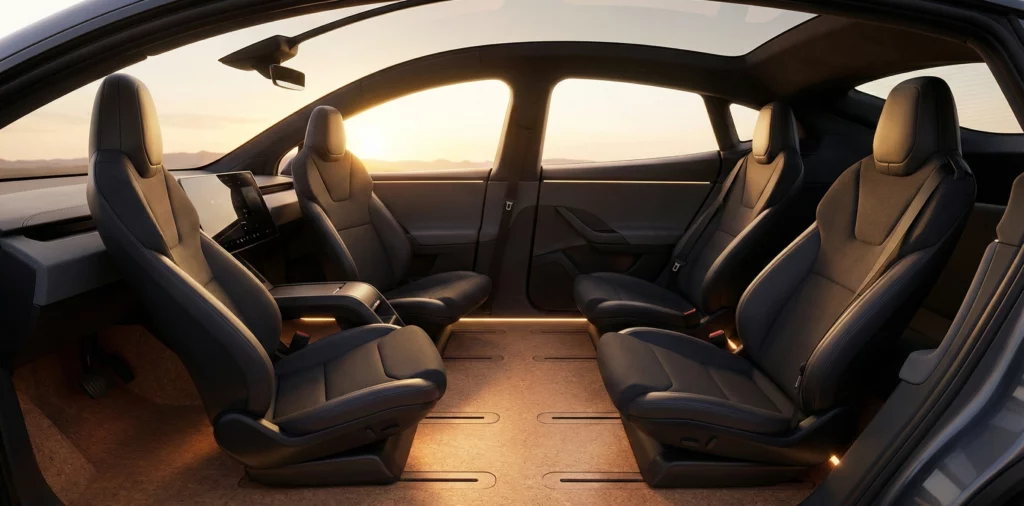
Accurate Weight and 3D Force Sensing for Car Seats
At 100km/h, Algorithms Guess.
Physics Knows.
Movetrics Vector:
The first structural biometric interface for the automotive industry. Achieving Euro NCAP 2026 precision without the drift of pressure mats or the privacy risks of cameras.
Gravity does not lie.
The Era of “Good Enough” is Over.
For twenty years, the automotive industry has relied on a compromise. To detect passengers, we buried sensors inside seat cushions—fighting a losing battle against foam aging, temperature hysteresis, and the laws of thermodynamics.
Then came the cameras. They promised intelligence but delivered privacy nightmares, GDPR roadblocks, and failure in the dark.
And now, Euro NCAP 2026 demands the impossible:
- You must distinguish a 30kg child from a 30kg box.
- You must detect “Out-of-Position” (feet on dashboard) instantly.
- You must do it without invasive surveillance.
The old tools are broken. You cannot solve a physics problem with better software. You must solve it with better mechanical engineering.
The Challenge: Euro NCAP 2026
New regulations demand accurate occupant classification. Current solutions fall short.
Stature Classification
4 points for classifying 5th, 50th, and 95th percentile occupants
Child Presence Detection
5 points for detecting children, even under blankets
Out-of-Position Detection
2 points for detecting dangerous occupant positions
Crash Occupancy
5 points for accurate eCall occupant data.
We Moved the Measurement.
We Fixed the Problem.
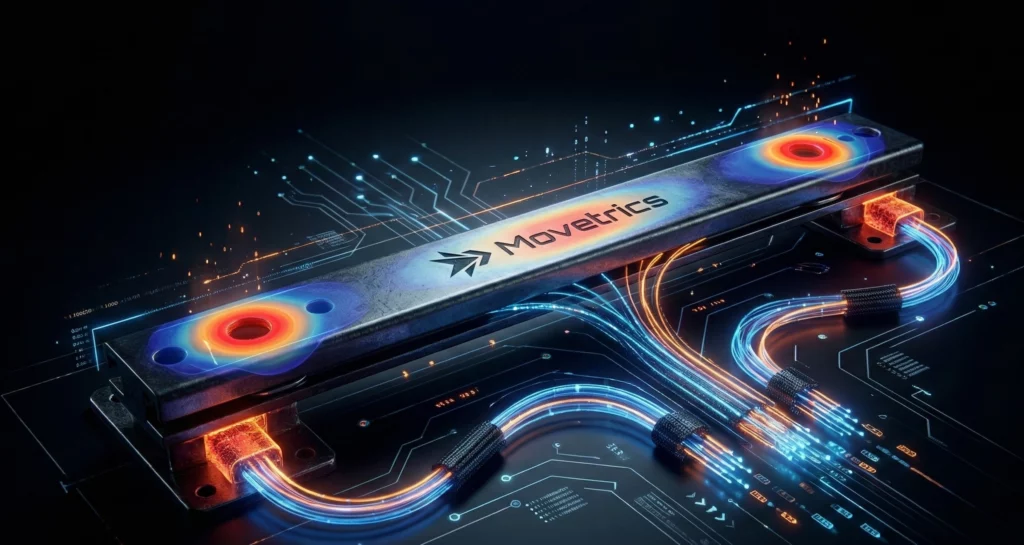
Movetrics Vector Platform is not a sensor pad. It is a structural evolution of the seat rail.
By integrating a patented multi-axis load cell array directly into the chassis interface, we bypass the seat cushion entirely.
We do not measure surface pressure. We measure Reaction Force.
The “Structural Truth” Architecture:
- Kinematic Decoupling: Our patented spherical-bearing interface isolates vertical load Fz from chassis torque. Even if the car floor flexes during cornering, the measurement remains absolute.
- Zero-Drift Steel: Unlike capacitive sensors or foam, steel does not age. It does not harden in winter or soften in summer. It requires zero recalibration over the vehicle’s lifespan.
- 20mm Integration: A low-profile, drop-in architecture compatible with standard Faurecia, Adient, and Lear seat track profiles.
Two Products. One Platform.
Lead with proven and cost-effective weight measurement. Differentiate with revolutionary 3D force analysis.
✔ Prototype Ready
Movetrics Vector-Z
Accurate, temperature-stable passenger weight measurement for Euro NCAP 2026 compliance. Prototype built and ready for proof of concept demonstration and pilot programs.
| Weight Accuracy | ±3% |
| Temperature Range | -40°C to +85°C |
| Response Time | <10ms |
| Target Price | $15-20 per seat |
| Target SOP | 2028 model year |
In Development
Movetrics Vector-S3
Revolutionary three-dimensional force measurement enabling predictive safety features. The only automotive sensor capturing X, Y, and Z-axis forces simultaneously.
| Force Measurement | X, Y, Z Axes |
| Bandwith | 0-20 Hz |
| CoP Accuracy | ±10 mm |
| Target Price | $30-80 per seat |
| Target SOP | 2029-2030 |
Why the Movetrics Vector Platform Wins
Superior accuracy. Lower cost. Unique capabilities.
| Criteria | Pressure Mats | In-Cabin Cameras + Radar | Movetrics Vector |
|---|---|---|---|
| Primary Metric | Indirect Surface Pressure | Estimated Visual Volume | Direct Force Physics |
| Drift / Aging | High (Foam Decay) | N/A | Zero (Structural Steel) |
| Privacy | No cameras | Camera required | No cameras |
| Darkness Performance | Excellent | Fails / Requires IR | Excellent |
| Through-Blanket Detection | Yes | Fails | Excellent |
| Out-of-Position Detection | Poor | Good | Precision (CoP) |
| Integration Complexity | Medium | High | Low |
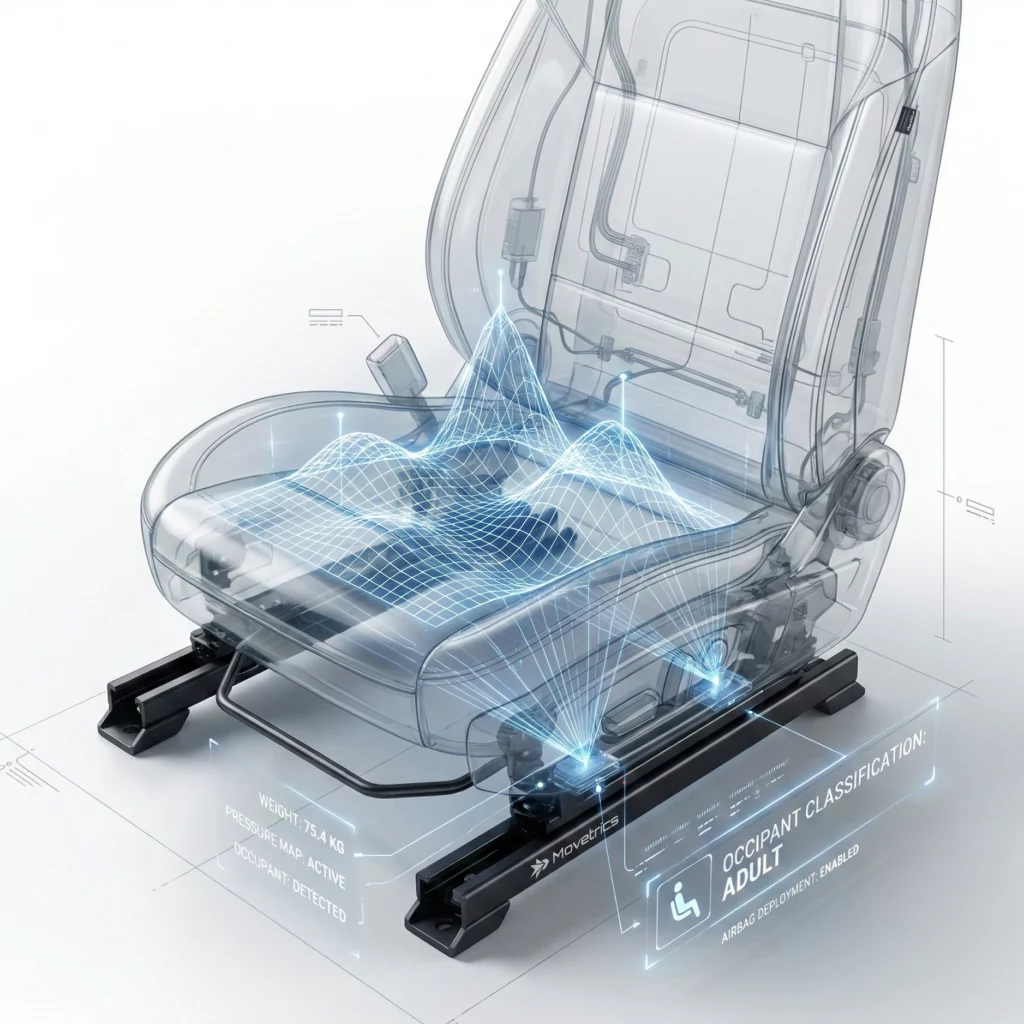
Movetrics Vector Platform
Vector-S3 Technology
✔ Direct Load Path
Sensors integrated into the structural rail provide absolute ground truth. No inference. No drift.
✔ Un-Occluded Reality
Works under blankets, in pitch black, or with complex clothing layers. Gravity cannot be occluded.
✔ Differential CoG
Separates the Passenger Frame of Reference from the Chassis Frame of Reference, isolating true occupant behavior from vehicle dynamics.
What 3D Force Analysis Enables
Move beyond measuring weight.
Pre-Crash Occupant Positioning
- Monitor occupant during emergency braking
- Predict trajectory in imminent crash
- Optimize airbag deployment timing
- Impact: Injury Reduction
Dynamic Restraint Adjustment
- Adjust pretensioner force in real-time
- Modulate airbag deployment based on dynamics
- Compensate for occupant movement
- Impact: Personalized Protection
G-Force Monitoring and Analysis
- Track occupant exposure to accelerations
- Detect motion sickness conditions
- Monitor driver fatigue
- Impact: Enhanced safety analytics
Autonomous Vehicle Safety
- Monitor occupants in non-standard positions
- Detect readiness for manual takeover
- Assess post-crash occupant condition
- Impact: Future-proof architecture
Questions and Answers
Why not just use cameras for Out-of-Position detection?
Cameras require line-of-sight. If a passenger is sleeping under a blanket, reading a large newspaper, or sitting in darkness, the camera is blind. Furthermore, cameras face massive GDPR scrutiny for recording biometrics in the cabin. Tensoa measures force—which cannot be hidden and is privacy-neutral.
Do your load cells drift over time?
We use a patented kinematic decoupling interface that isolates the load cells from chassis torque and thermal expansion. Unlike foam-based sensors that degrade and harden over years, structural steel maintains calibration for the vehicle’s lifespan.
How does this integrate with current seat designs?
Vector-S3 is a drop-in structural component. It sits between the seat rail and the chassis, adding only ~20mm of Z-height. It utilizes standard mounting bolts and requires no redesign of the seat foam, trim, or heating elements.
What is the data latency?
<10ms. Because we measure direct reaction force, there is no complex image processing lag or AI inference time. This speed is critical for pre-crash restraint deployment (e.g., pretensioners).
We Are Looking for a Partner
The Euro NCAP 2026 deadline is approaching. OEMs need compliant solutions. Current technologies are inadequate.
NUR Engineering is an engineering innovation house based in Duisburg, Germany. We hold the patents, the algorithms, and the working prototypes.
We are currently validating the Vector-S3 architecture for SOP (Start of Production). We are seeking ONE exclusive Tier 1 industrialization partner to bring this technology to the global OEM market for Model Year 2027/28.
We have one proof of concept prototype ready to test today. Compare the data aginst your existing pressure mats or weight sensors. The physics will speak for itself.
As our exclusive partner, you’ll get:
- First-mover advantage in 3D force measurement
- Exclusive automotive rights for 10 years
- Proven technology (prototype ready)
- Patent-pending IP portfolio
- Joint go-to-market support
Contact Us
Movetrics
Nur Engineering GmbH
Am Buchenbusch 63
47229 Duisburg
Germany