Movetrics FDT · Force Data Terminal
One clock for every force plate.
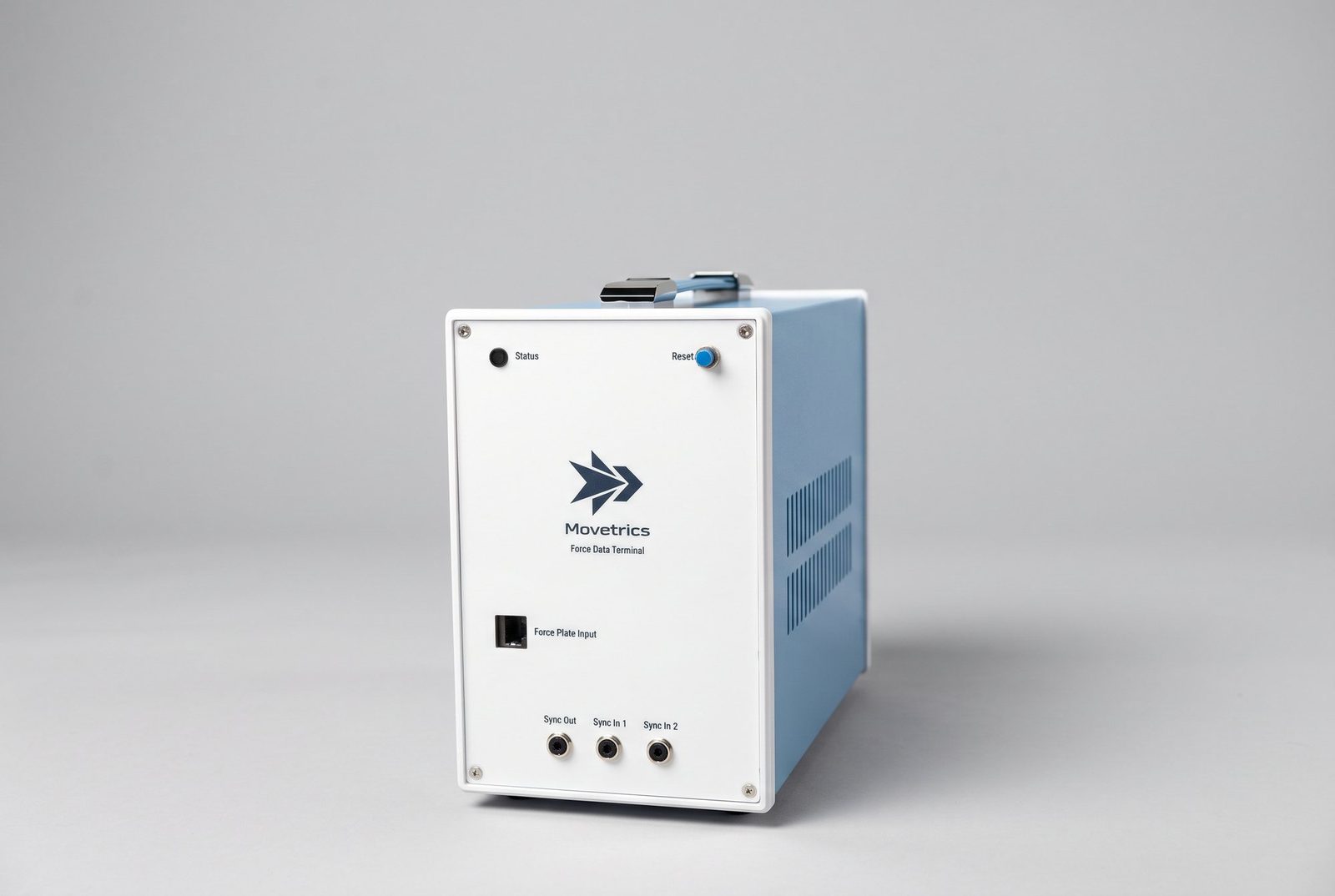
The Force Data Terminal connects multiple plates on one shared clock and sends their data to a computer, a phone or tablet, or the analog inputs of your laboratory.
0.1 ms
timestamp steps
16
analog outputs, ±10 V
USB-C
plus Bluetooth LE
1.75 kg
27 × 21 × 14 cm, rechargeable
Plates in, data out.
All plates share one cable to the FDT, carrying both data and power. The FDT puts every sample on one clock, so left and right, or four plates under a treadmill, line up to the tenth of a millisecond.
For every user
To Movetrics Studio on Windows, the Movetrics app on a phone, tablet or Mac, or Movetrics Cloud in the browser.
For the laboratory
16 analog outputs for two plates, and Sync In and Sync Out (3.5 mm, TTL 3.3 V) for the rest of your equipment.
For developers
A documented, open protocol and an SDK under Apache-2.0, so your own software reads the same stream. For developers.
How it connects.
| Plates | One or more F1-3D or F1-3D S, on one common shielded cable |
| USB-C | Movetrics Studio on Windows, the Movetrics app on a Mac, Movetrics Cloud in the browser, Android with OTG |
| Bluetooth LE | The Movetrics app on a phone or tablet, one device at a time |
| Your own software | The open protocol and the SDK |
| Laboratory | 16 analog outputs, Sync In, Sync Out |
Technical data
Plates and data
| Plates | Multiple F1-3D or F1-3D S. One RJ45 port for all plates: data and power on one shielded cable, up to 25 m |
| Samples per second | 2,000 with one or two plates, 1,000 with three or more |
| Time base | One clock for all plates; timestamps in 0.1 ms steps |
| Output resolution | 1 N for forces, 1 N·m for moments |
| Protocol | Documented and open: 24-byte frames and commands, published in the SDK under Apache-2.0 |
| Firmware | Signed updates with automatic rollback; plate firmware is updated through the FDT |
| USB-C | To a computer: Movetrics Studio on Windows, the Movetrics app on a Mac, Movetrics Cloud in Chrome, Edge or Firefox on Windows, macOS, Linux and ChromeOS. To Android phones and tablets with OTG |
| Bluetooth LE | Pre-certified radio module. To a phone or tablet, one device at a time |
| Good to know | Use one link at a time |
Laboratory, power and housing
| Analog outputs | 16 outputs, ±10 V, DB-25 female, for plates 1 and 2: Fz, Fx, Fy, Mx, My, Mz, CoP x and CoP y for each |
| Scaling | 16-bit. Full scale: Fz ±8,000 N (1.25 mV/N); Fx and Fy ±2,000 N (5 mV/N); moments ±720 N·m (13.89 mV/N·m); CoP x ±15 cm, CoP y ±30 cm. Outputs clamp at full scale |
| Analog updates | Up to 500 per second per plate, within 1 % of the digital values |
| Sync In, Sync Out | 3.5 mm mono jacks, TTL logic level, 3.3 V |
| Power | Rechargeable battery. Charges over USB-C from the connected computer or phone, or through the 12 V jack; 12 V power adapter included |
| Size and mass | 27 × 21 × 14 cm, 1.75 kg |
| Ports | RJ45 for the plates, USB-C, DB-25 analog out, Sync In, Sync Out, 12 V jack, micro-USB developer port; power and reset buttons |
| Conformity | CE marked |
| Guarantee | 2 years on the FDT (Movetrics Guarantee) |
Tell us what you want to measure.
Make your offer online and download it as a PDF straight away. Questions get an answer within one working day.
Specifications may change. The current edition is always on this page and in the product sheet (PDF, English) and Produktblatt (PDF, Deutsch).
Intended use. Movetrics systems measure forces and moments, calculate metrics and display them, for sport, research, education, and practitioner-led training and rehabilitation. They are not medical devices. They do not diagnose, treat, monitor or predict any disease or condition, and their results do not replace professional judgement.
Straight answers
How many plates can one FDT take?
Multiple F1-3D or F1-3D S, on one clock: 2,000 samples per second with one or two plates, 1,000 with three or more. Four F1-3D S under a treadmill run on one FDT. Larger layouts on request.
Can it work with our motion capture or EMG?
Yes. Sync In and Sync Out (3.5 mm, TTL 3.3 V) share a trigger with the rest of your laboratory, and 16 analog outputs (±10 V) carry the forces, moments and centre of pressure of plates 1 and 2 into any analog input. The Lab Streaming Layer tool streams the digital data to research set-ups with several devices.
Computer and phone at the same time?
Use one link at a time: USB-C to a computer or phone, or Bluetooth LE to one phone or tablet.
Who stands behind it?
Nur Engineering GmbH in Duisburg, developing sensors since 2012. Invented, designed, built and assembled in Germany, CE marked, with two years of guarantee on the FDT. Support in English, German, Italian and Arabic, by email and phone; we answer within one working day.